Consumers say all the right things about debt. They say they want to pay it off sooner and find ways to reduce interest. And, the majority (61%) say they feel in control of their debt. But…
Reality is a little messier.
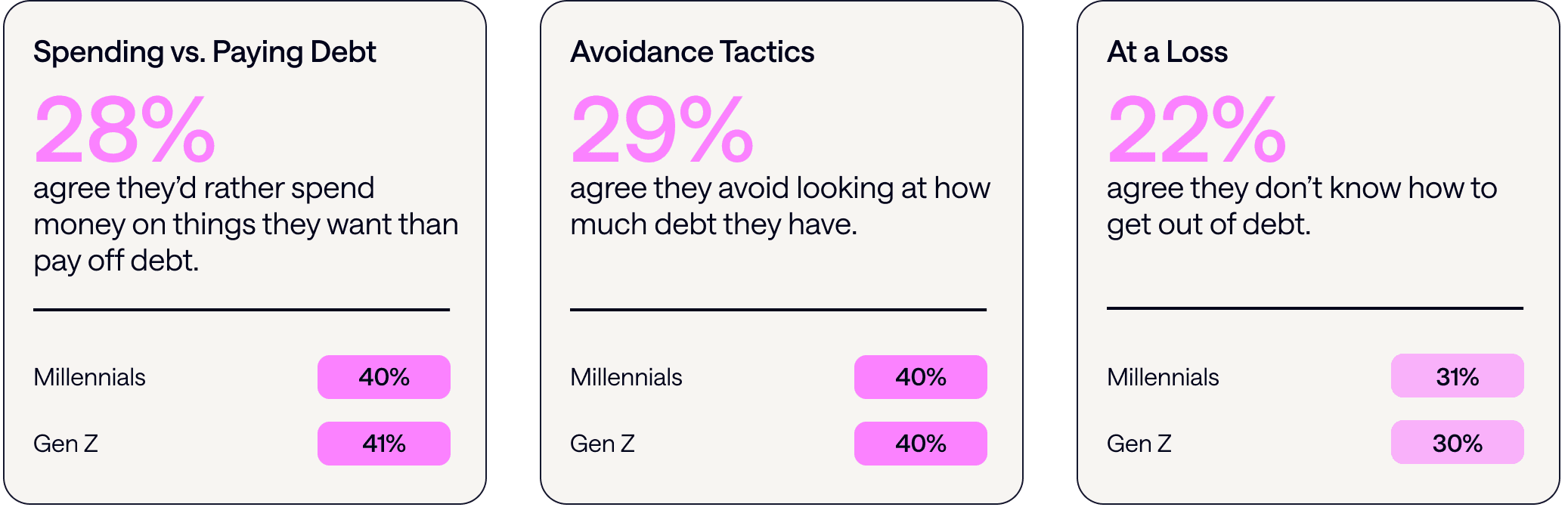
Less than one-third of consumers know exactly how much they owe across all their accounts. Twenty-nine percent agree they avoid looking at how much debt they have – and this jumps to 40% among Millennial and Gen Z consumers. And, a majority of consumers have discovered at some point that they owed significantly more than they thought.
The reality is financial behavior rarely fits neatly into categories like “responsible” or “irresponsible.” Consumers are constantly weighing one financial priority against another, often without having the full picture in front of them.
Spinwheel’s latest Spin Signal survey of more than 600 U.S. consumers explores the gap between how consumers think about debt and how they actually manage it — and how AI is beginning to change the way they approach their finances.
Par for the Course: Consumer Attitudes about Debt
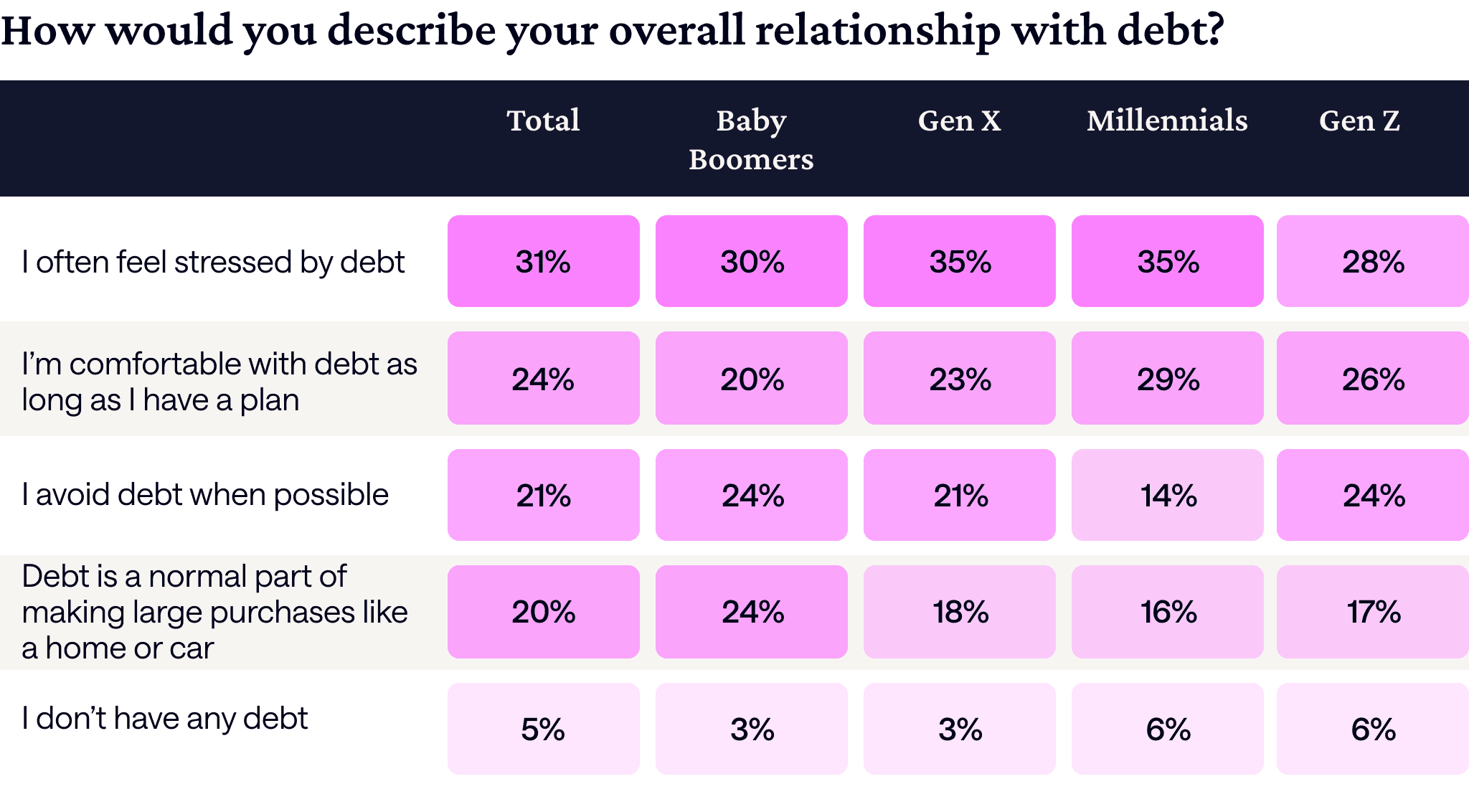
For 1 in 5 consumers, debt is simply part of life. Twenty percent believe debt is a normal part of making large purchases like a home or car. That attitude becomes more common among older generations — 26% of Baby Boomers believe this compared to just 17% of Gen Z.
At the same time, nearly one-quarter of consumers (24%) say they are comfortable with debt as long as they have a plan. Those perspectives describe a fairly pragmatic view of borrowing: debt can be acceptable when it serves a purpose.
That said, the prevailing relationship with debt is still one of stress and avoidance. The largest portion of consumers — 31% — say they often feel stressed by debt. Another 21% of consumers avoid debt whenever possible.
Only 5% of consumers in this survey say they don’t have any debt. This means that for the overwhelming majority, debt is not something they can opt out of. The more important question is whether they understand what they owe and feel capable of managing it.
Most Consumers Don't Know Exactly How Much They Owe
How much debt do you actually have? Many consumers operate on estimates when it comes to this question.
When asked how well they know the total amount of debt they currently owe across all of their accounts, nearly half (47%) of consumers say they know approximately how much they owe. Another 10% say they know how much they own on some accounts but not all and 9% say they know they have debt but don’t know the total amount.
Most concerning, a small portion (2%) intentionally avoid calculating how much they owe — and this doubles to 4% for Baby Boomers and Millennials.

Despite not knowing an exact number, the majority of consumers (61%) agree they feel in control of their debt. At the same time, 66% say they are very or extremely confident they understand how much their debt costs them. Another 26% are somewhat confident.
But, this confidence becomes harder to reconcile with the bigger picture of what consumers say actually do:
Yet consumers also say they want to make smart financial decisions. More than half (69%) say they regularly look for ways to reduce or limit the amount of interest they pay on their debt. Gen Z leads the way at 73%.
And, 55% say they are willing to take on debt if it helps them accomplish an important financial goal. Again, younger consumers are particularly comfortable with that tradeoff: 64% of Gen Z and 57% of Millennials agree.
But, how much sacrifice today makes sense when financial security feels out of reach? Or the reality of sacrificing feels too hard?
The willingness to make those tradeoffs does not happen in a vacuum. Consumers are making financial decisions against a backdrop of uncertainty about whether traditional financial habits will actually get them to their goals.
A Harder Financial Future Changes the Equation
Most consumers haven't rejected traditional financial discipline. They are questioning whether it is enough. Thirty-six percent believe that making responsible financial decisions now can help them build the financial future they want.
But, a larger majority (39%) believe responsible financial decisions matter, but getting ahead feels much harder than it used to. And, 13% sometimes question whether sacrificing today is worth it when major financial goals still feel out of reach.
This pessimistic outlook may be influencing day-to-day spending behaviors and debt decisions among consumers. Today, 8% of U.S. consumers surveyed say they would rather enjoy their money now than sacrifice for financial goals they may never achieve. Likewise, 5% do not believe traditional financial habits, such as saving, paying down debt, and investing consistently, are enough to get ahead anymore.
Actions Speak Louder than Words: How Consumers Actually Manage Debt
On the surface, consumers sound highly motivated to pay down debt. Despite the pessimistic outlook on achieving financial goals, the vast majority of consumers (77%) say they are willing to make sacrifices today to become debt-free sooner.
That sounds encouraging. But intentions only tell part of the story. When consumers describe what they actually do with their debt, their strategies are much more varied.
Approaches to Paying Down Debt Vary
Nearly 3 in 10 consumers (29%) say they pay more than the minimum whenever they can on debt owed. But, 1 in 4 are focused on staying current rather than accelerating payoff:
12% say they pay what they owe but don’t prioritize paying it off early
13% just pay the minimum amounts due each month
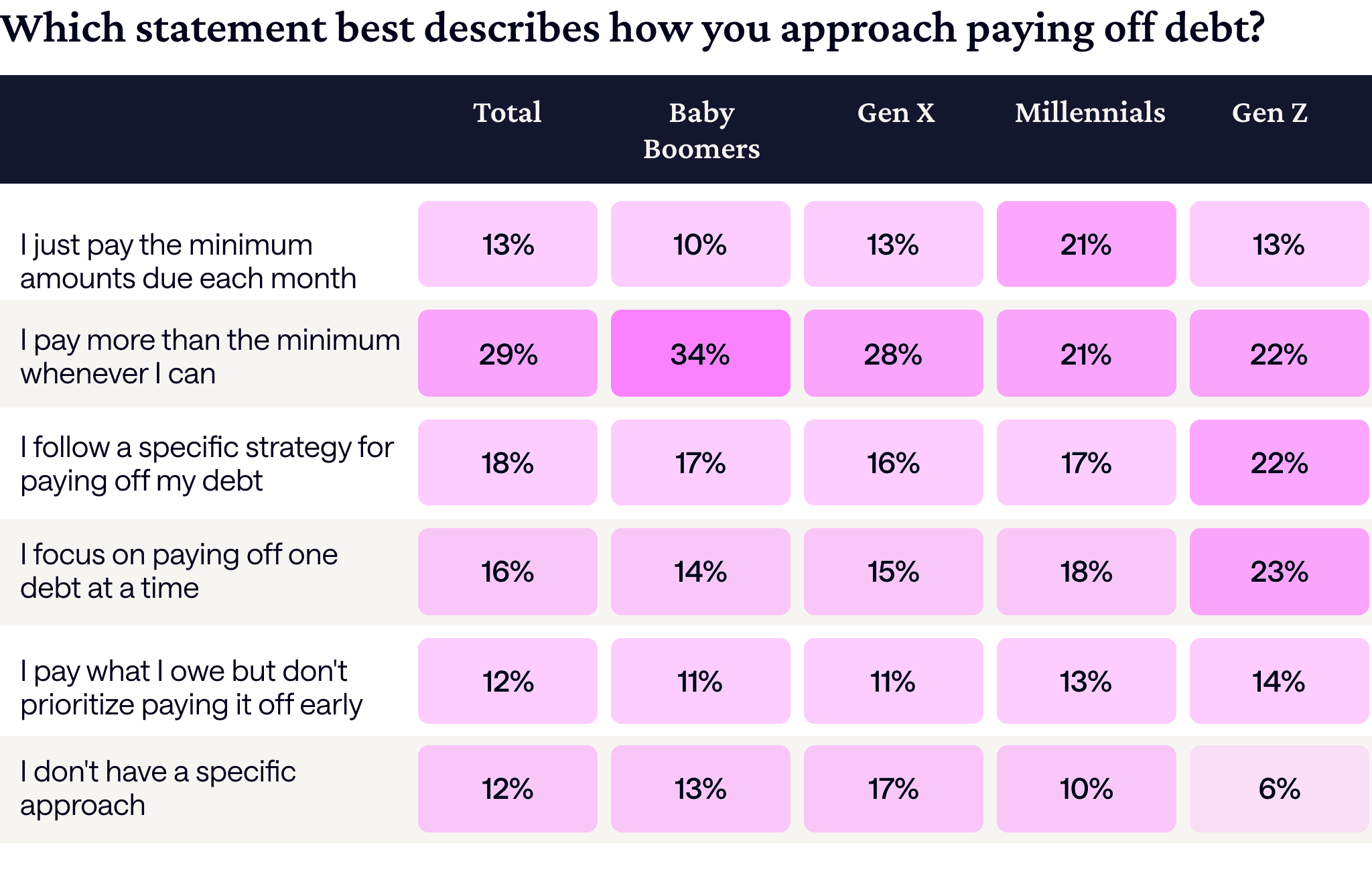
Generational differences also show up in how they prioritize paying off debt. Baby Boomers are even more likely to pay more than the minimums (34%). Meanwhile, Gen Z is essentially split across several approaches:
23% focus on paying off one debt at a time
22% say they pay more than the minimum whenever they can
22% follow a specific debt payoff strategy
More broadly, more than 1 in 10 consumers say they do not have a specific approach. Among Gen X, that rises to 17%.
And a payoff strategy is only useful if consumers have enough information to know which debt deserves their attention.
An Extra $1,000 Doesn't Automatically Go Towards Debt
Give consumers an unexpected $1,000 and debt payoff is not necessarily the first priority. While there is no universally correct answer when a consumer experiences a windfall, less than 4 in 10 consumers would put the entire $1,000 toward debt. And, this is despite the majority of consumers saying they would make sacrifices to pay off debt sooner.
Only 16% would put it toward their highest-interest debt. Another 22% would put it toward the debt with the smallest balance to pay it off sooner while 26% would split the money between paying down debt and saving.
Another 25% would put it into savings or an emergency fund.
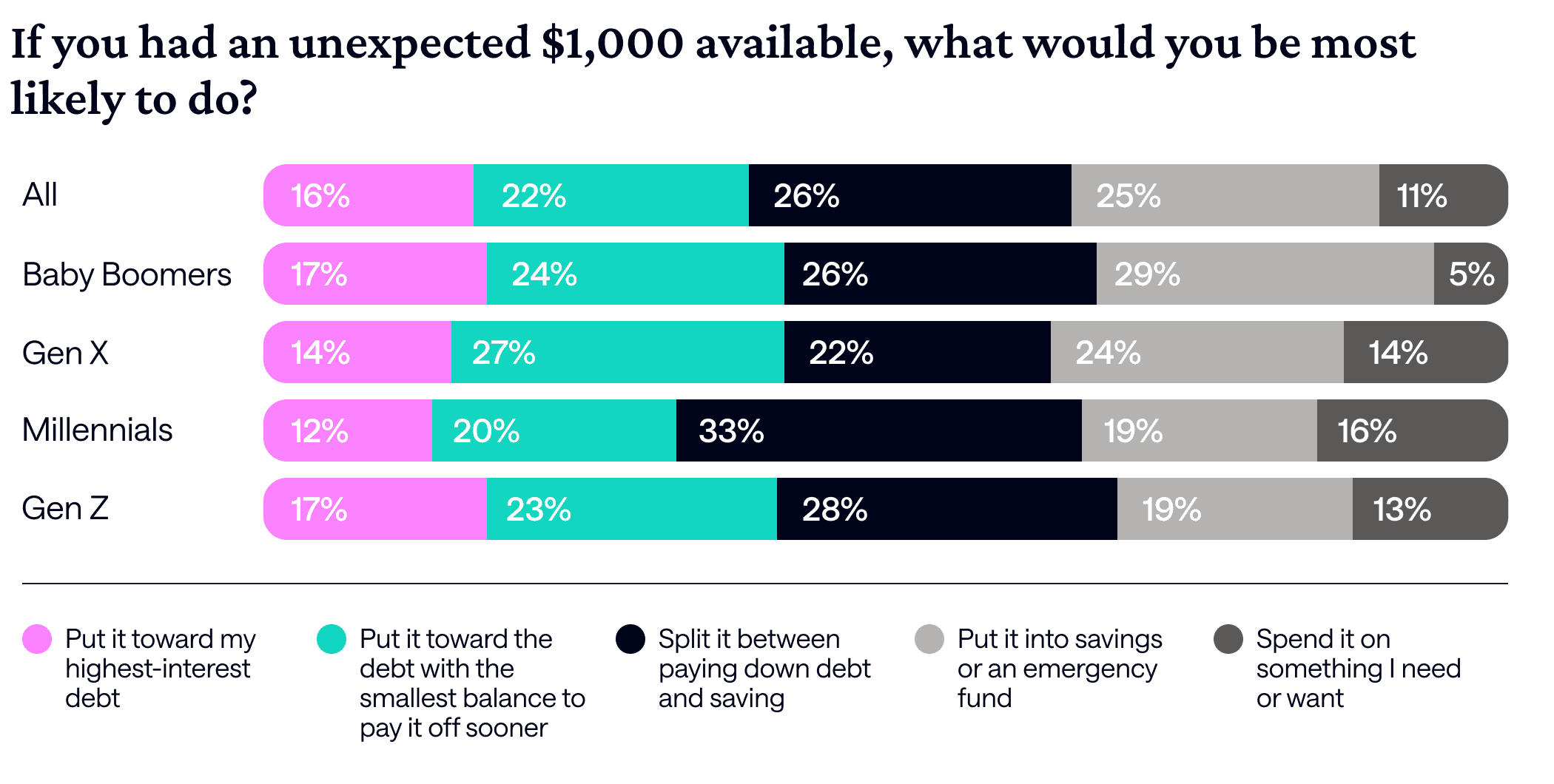
Think about it: More than half of consumers would not use a financial windfall exclusively to pay down debt. Consumers may not be choosing spending over responsibility. But, they are asking a broader question than if they should pay down debt. Instead, the question is: “What problem am I trying to solve with this money?”
Debt Is Often Bigger Than Consumers Think
Sixty-one percent say they have discovered that they owed significantly more money than they thought they did. For 1 in 3 consumers, it has happened multiple times.
Younger consumers are especially likely to have experienced this. Eighty percent of Gen Z say they have discovered they owed significantly more than expected, with 49% saying it has happened multiple times.

When nearly two-thirds of consumers have underestimated their debt at some point, "approximately" knowing what you owe starts to look like a meaningful financial risk rather than a harmless estimation.
Consumers Have Different Definitions of Financial Progress
The data points to a broader truth about debt: consumers are not all trying to accomplish the same thing.
For some, the goal is simple. Get out of debt as quickly as possible. For others, the priority is minimizing the total cost of borrowing. Some want a clear plan they can follow, while others are more focused on keeping monthly payments manageable.
We see those differences clearly when consumers describe their overall debt style.
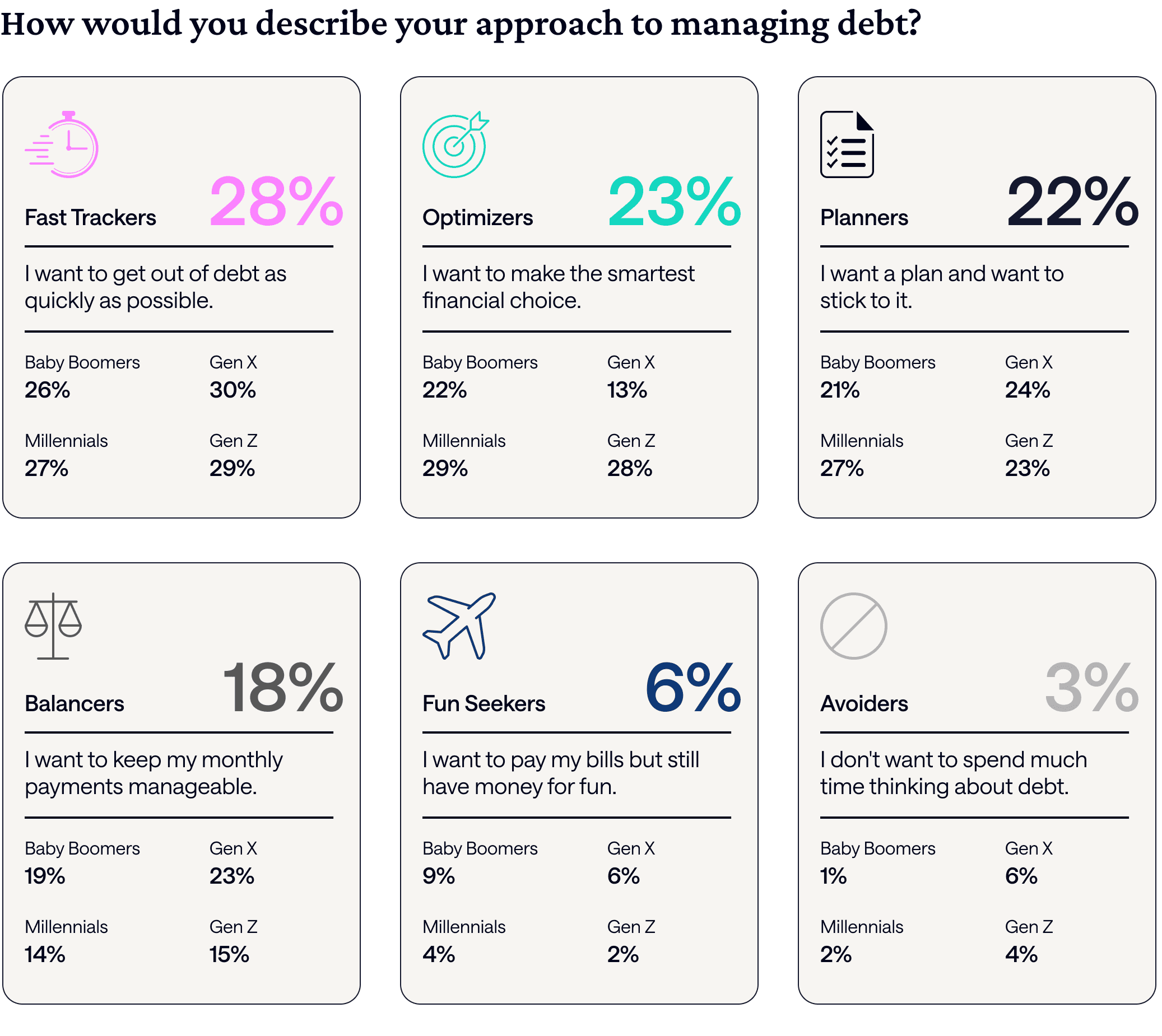
What stands out is how evenly distributed these approaches are. No single debt style comes close to representing even one-third of consumers. Fast Trackers are the largest group at 28%, but Optimizers and Planners are close behind at 23% and 22%. Another 18% identify as Balancers.
No single debt style represents even one-third of consumers. That matters for financial providers: there is no single definition of financial success.
Some want speed. Some want optimization. Some want predictability. Some want flexibility. The best financial experiences should account for those differences rather than forcing every consumer into the same repayment framework.
Consumers are making different choices because they are solving different problems.
Financial Risk Stays in the Picture
Not all tradeoffs are equally calculated. Some consumers are taking meaningful financial risks in pursuit of short-term rewards or the possibility of getting ahead faster.
Thirty-one percent say they have gone shopping when they didn’t have money to spend. That jumps to 46% among Gen Z. Another 31% have participated in sports betting, gambling, or the lottery, including 44% of Millennials and 40% of Gen Z.
Then the behaviors get more financially consequential.
Twelve percent have participated in prediction markets — rising to 28% among Gen Z and 21% among Millennials. More consequentially, 11% of consumers have borrowed money to invest or trade — jumping to 24% of Gen Z and 20% of Millennials.

For each of those behaviors, younger consumers are substantially more likely to participate. The issue is not just participation — or borrowing money to do so. Some consumers are also making these choices at the expense of other financial priorities.
7% say they have delayed paying down debt to invest or trade instead. That rises to 15% among Gen Z and 13% among Millennials.
5% have delayed paying down debt to gamble or participate in prediction markets, including 9% of Gen Z and 8% of Millennials.
12% have taken a significant financial risk in hopes of making money quickly. Among Millennials, that reaches 25%.
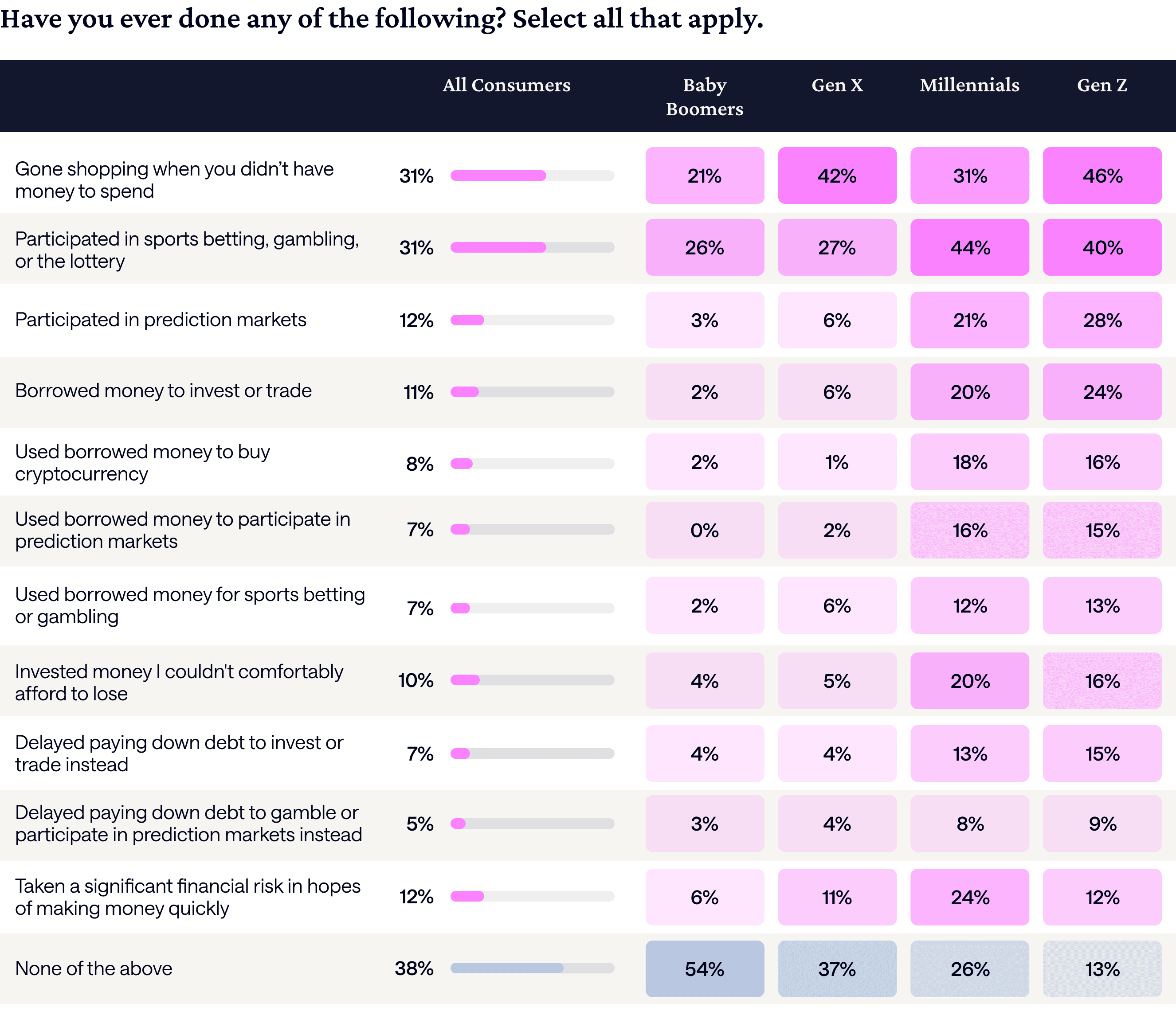
Taken together, these behaviors blur the line between spending, investing, speculation, and debt. This makes the job of financial guidance and debt management harder. Consumers do not just need to know what they owe. They need to understand what different choices could mean for the financial future they are trying to build.
Yet, the tools consumers use to manage all of this information are still remarkably manual. Spreadsheets, lender websites, budgeting apps, and mental math are doing a lot of the work. AI is starting to change that.
Copilot or Autopilot: How Consumers Leverage AI to Manage Finances
The way consumers track debt hasn’t changed much in decades. Thirty percent still use a spreadsheet or document. Twenty-six percent check individual lender or creditor apps and websites. Seventeen percent use a budgeting or financial management app. And 19% do not actively track their debt at all.
The result is a fragmented consumer experience in which the information needed to make a debt decision may live in several different places. That becomes a problem when balances change faster than the consumer's mental model.
But, AI may be helping to change this dynamic. AI adoption in personal finance is already nearing the halfway mark.
When asked if they have ever used an AI tool to help manage their personal finances, 46% of consumers said yes in some form:
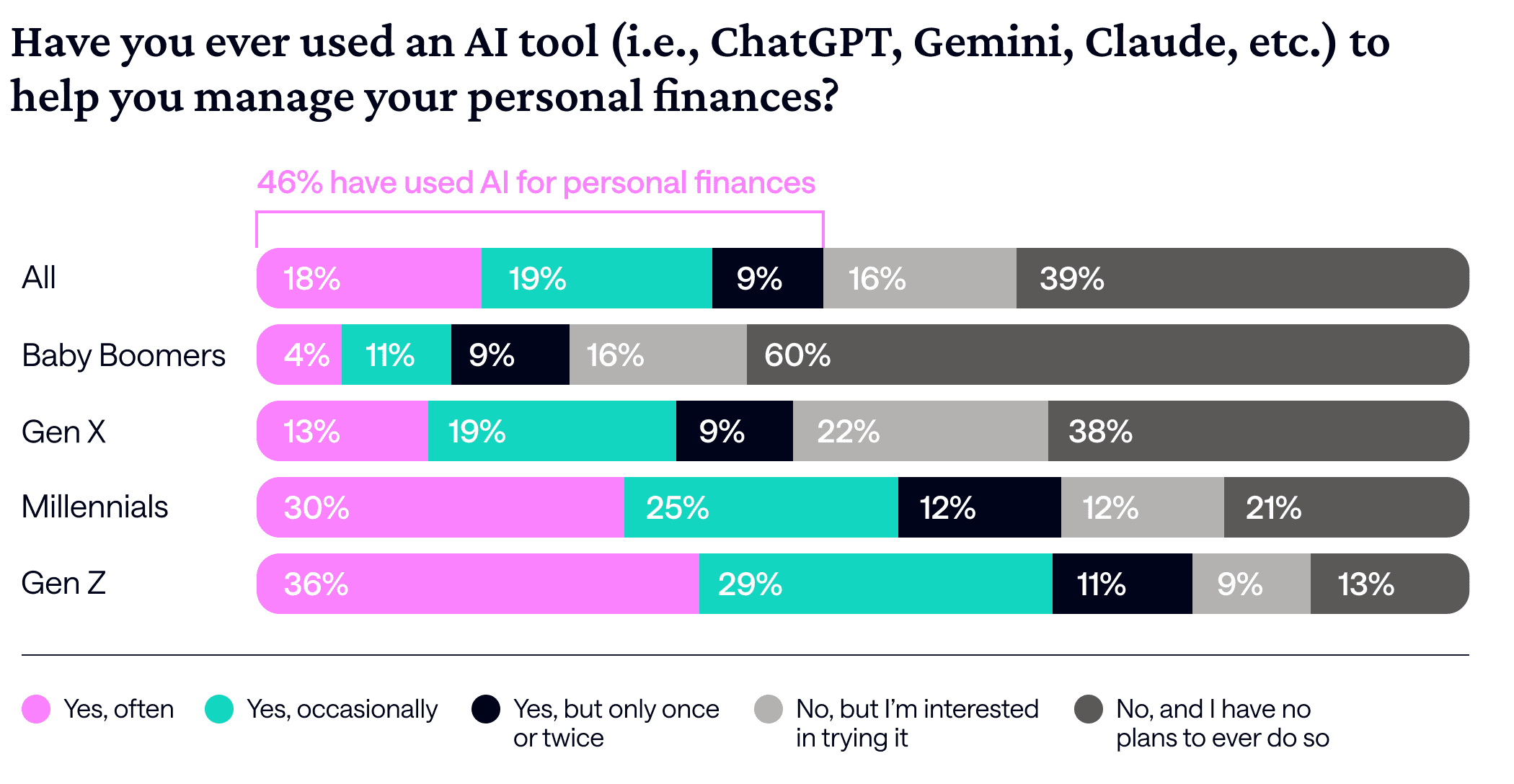
For now, consumers are using AI mostly to help them understand, organize, and evaluate their finances. The closer the task gets to actually moving money or making a consequential financial decision, the more cautious they become.
AI Is Moving From Financial Answers to Financial Actions
Among consumers who have used AI to manage their personal finances, the most common uses still center on information and guidance. The top two use cases are finding ways to save money and answering general financial questions.
But the third most common use case is more interesting: 30% say they have used AI to pay bills. Consumers aren't just asking AI about their finances. They're beginning to use it to do things.

Consumers are moving beyond discovery and education when it comes to leveraging AI to help manage their personal finances. But, they are still selective about what they are willing to let AI do.
When asked why they used AI to help them, the biggest group of consumers are coming from a place of curiosity:
19% were curious to see how AI could help.
17% wanted easy access to financial guidance tailored to their specific situation.
16% prefer using technology to manage things whenever possible.
16% wanted a quick answer without doing the research themselves.
14% wanted help making sense of something they found confusing.
10% said someone recommended they try it.
For consumers who haven't adopted AI, the barrier isn't always distrust. For many, it's simply unclear value:
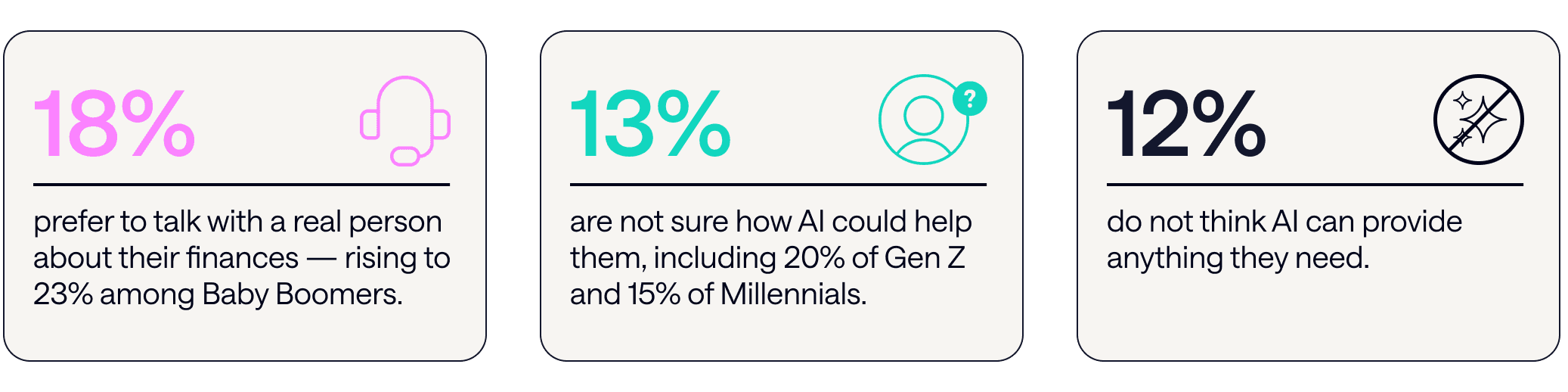
That said, trust still remains an issue. Sixteen percent do not trust AI to provide reliable financial guidance, while 20% are uncomfortable sharing their financial information with AI.
This is a gap that financial providers will have to close. Consumers who are already comfortable with AI can see what it does for them. Others are still waiting for a compelling reason to put something as personal as their financial information into it.
AI's Potential in Debt Management
When consumers think specifically about debt, they see potential for AI to play a very active role. Most can identify at least one part of debt management where AI could help, from prioritizing balances to calculating payoff timelines and reducing monthly payments.
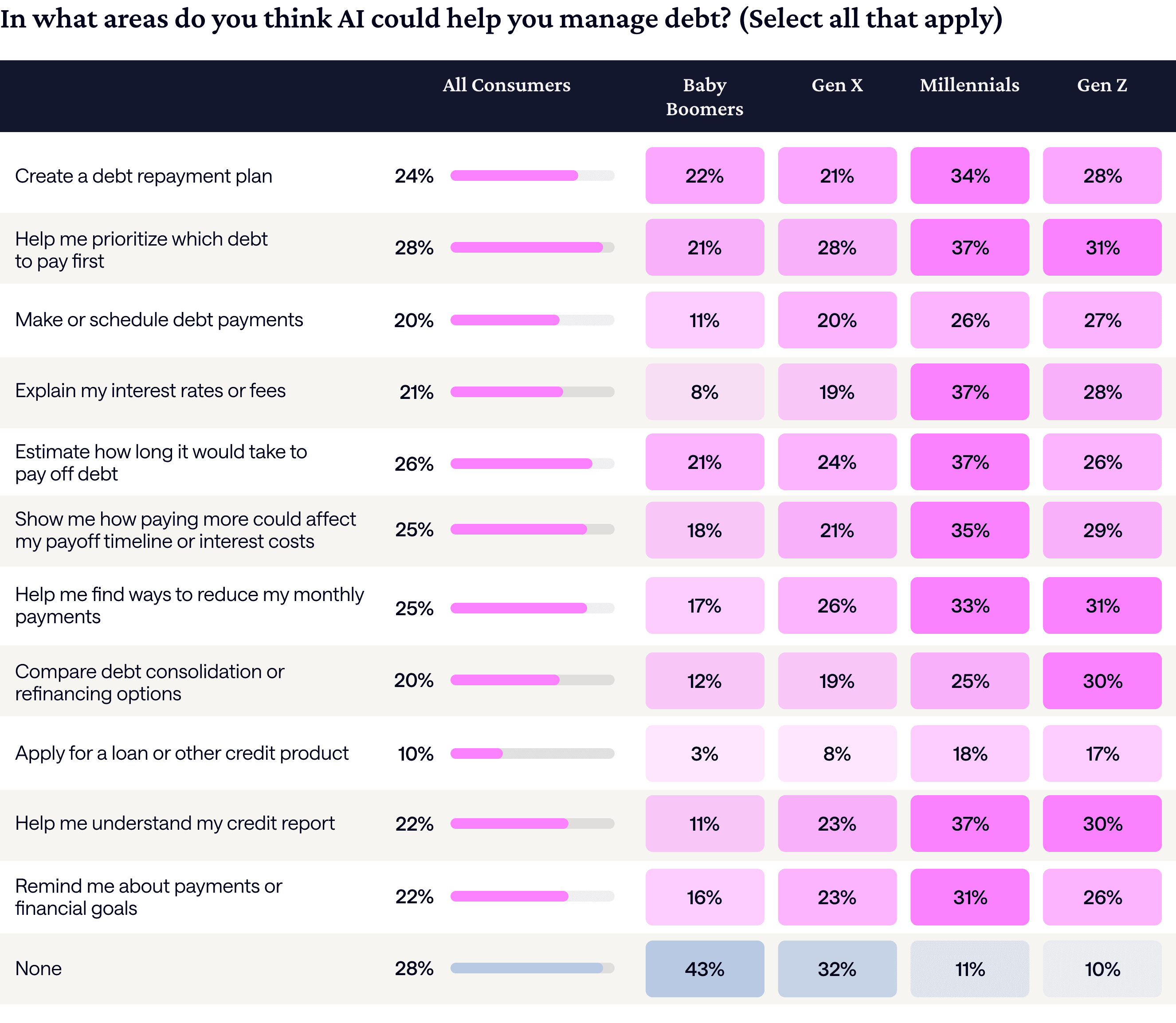
The most popular use cases are about helping consumers figure out what to do, not doing it for them. These are not really “AI” problems. They are problems consumers already have. AI simply gives them a new way to ask for help.
Trust in AI Is a Spectrum
Consumers are increasingly willing to trust AI with information and recommendations. Sixty-four percent at least somewhat trust AI to give them accurate information about their finances, including 34% who mostly or completely trust it. That rises to 79% among Gen Z and 82% among Millennials. Among Baby Boomers, it falls to 48%.
The same 64% at least somewhat trust AI to make recommendations about their finances. Again, younger consumers are considerably more comfortable: 79% of Gen Z and 80% of Millennials express at least some trust.
However, the picture changes when AI moves from advice to action. Thirty-one percent say they would not trust AI to take any financial action on their behalf. But, younger consumers are becoming more comfortable — only 13% of Gen Z and 15% of Millennials say the same.

Even among consumers willing to delegate actions to an AI tool, there is a clear hierarchy.
Thirty-one percent would trust AI to alert them when they may be at risk of missing a payment. The same share would trust it to find ways to reduce the interest they pay. Thirty percent would trust it to find ways to lower their monthly payments.
Then the numbers begin to fall. Twenty-five percent would trust AI to compare financial products or offers. Twenty-two percent would let it create or adjust a debt repayment plan. Fifteen percent would trust it to negotiate with a lender or creditor on their behalf.
Only 13% would trust AI to apply for a financial product or loan on their behalf. And when it comes to money movement, just 12% would trust AI to make routine payments on their behalf. Another 12% would let it transfer money between their accounts.
Today, consumers appear willing to give AI a seat at the table. They are considerably less willing to give it the checkbook.
What This Means for Financial Providers
Consumers are already bringing AI into their financial lives. The challenge for financial providers is turning that interest into an experience that works from question to decision to action.
For financial institutions and fintechs, that means thinking beyond the chatbot or financial copilot as a place to ask questions. The next step is connecting the intelligence AI provides to the actions consumers need to take.
Today, three gaps stand out:
1. AI needs the full financial picture.
An AI tool can only be as useful as the information it can access. A consumer may have balances with several lenders, money spread across multiple accounts, and financial information sitting in different systems. Asking an AI tool to help make a decision does not automatically give it access to all of that context.
The more financial decisions move into AI, the more important it becomes for providers to connect the right data, with the right permissions, at the right moment. However, today, many providers and AI tools still put the onus on the consumer to do the work to connect all of their accounts and data.
2. The experience breaks when it's time to take action.
Today, an AI conversation can get a consumer surprisingly far. It can answer a question, compare options, run calculations, and even help someone decide what they want to do.
Then, the handoff happens. The consumer must leave the AI experience to apply for a loan, make a payment, open an account, or complete another transaction. The work AI helped with does not necessarily follow the consumer into the next step. They may have to start the process again, re-enter information, or navigate a completely separate experience.
That creates a strange gap between an AI that can help someone decide what to do and an experience that can actually help them do it. The intelligence is there, but the transaction is somewhere else.
Agentic finance will require closing that gap. The value is not simply getting better at answering questions. It is carrying context and intent from the conversation into the transaction itself.
3. Consumers need control over what happens next.
The future of agentic finance does not have to be an all-or-nothing choice between a human doing everything and AI doing everything.
There is plenty of work in between.
AI can gather information, reconcile accounts, compare options, calculate outcomes, prepare applications, and handle routine tasks. The consumer can remain responsible for the decisions that require judgment or authorization.
That creates a different way to think about agentic AI. Instead of asking what percentage of financial transactions will eventually be handled entirely by AI, financial providers should ask how much of each transaction AI can handle on the consumer's behalf.
The future of AI in finance isn't choosing between copilot and autopilot. It's building a copilot capable of handling more of the work inside every financial transaction, while consumers remain in control of the decisions that matter.

Jessica Kendall
Head of Content and Communications