Americans are carrying record-setting debt levels. Federal Reserve Bank of New York data shows household debt reached $18.8 trillion at the end of 2025, with balances rising across nearly every major category.
But Spinwheel’s data suggests the real inflection point may not be how much consumers owe within a single liability. The real warning sign of financial stress may be complexity. Debt burdens do not rise gradually as borrowers take on additional obligations — they accelerate. More credit cards doesn’t mean higher balances across the board. And, the biggest debt burden (not including mortgages) for many consumers isn’t what you’d expect.
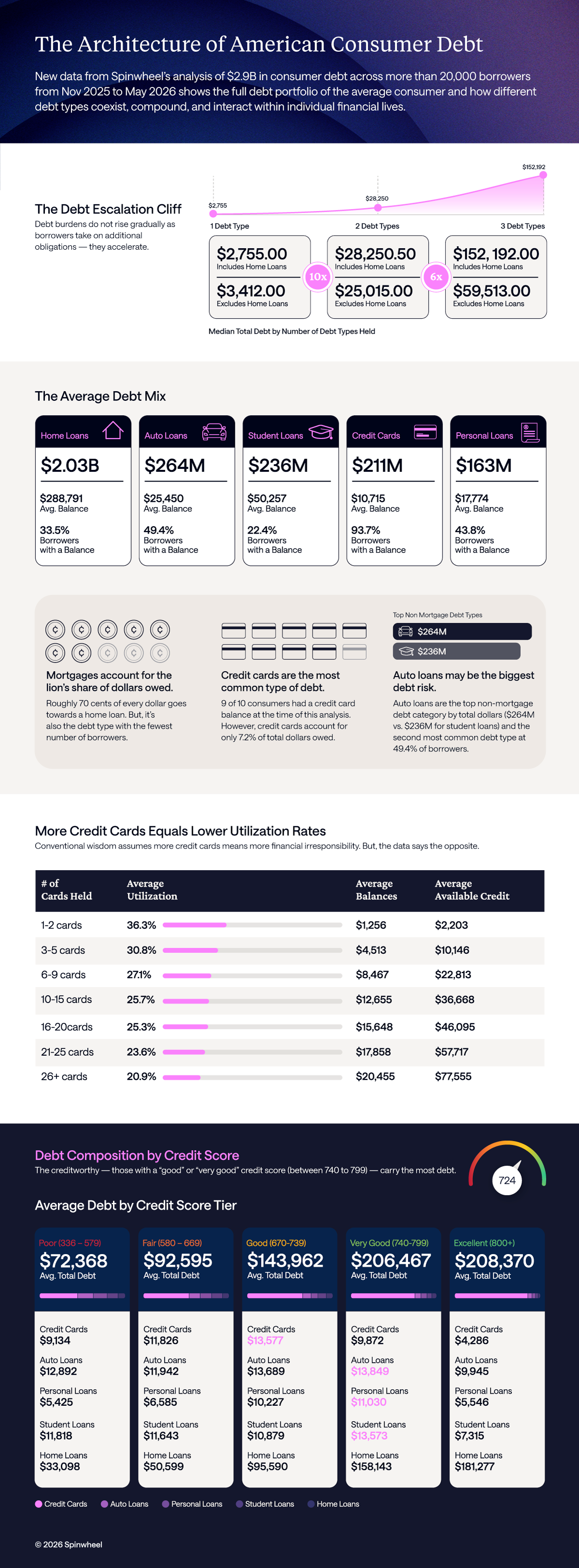
New data from Spinwheel’s analysis of $2.9B in consumer debt across more than 20,000 borrowers from Nov 2025 to May 2026 shows the full debt portfolio of the average consumer and how different debt types coexist, compound, and interact within individual financial lives.
The Debt Escalation Cliff
The most striking finding in the data is not about any single debt type. It's about what happens when borrowers add a second one.
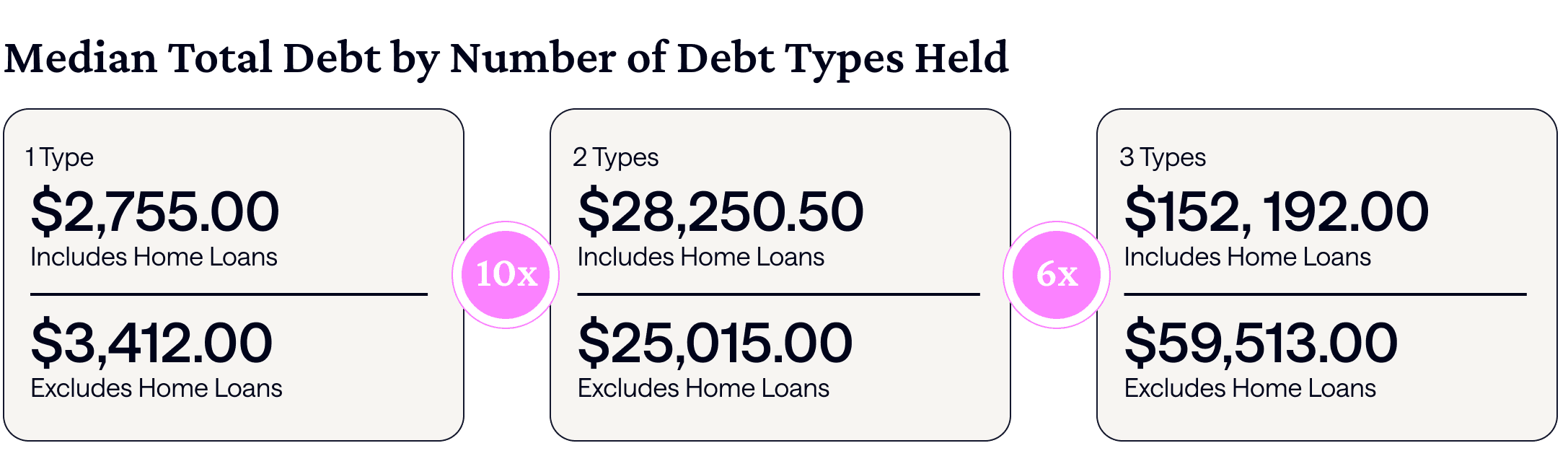
When consumers move from one debt type to two types of debt, the median debt balance increases by more than 10 times — from $2,755 to $28,250.50. The jump from 2 debt types to 3 is equally dramatic. Median debt balances are more than 6 times higher. This is likely driven heavily by home loans.
However, even if you exclude home loans, total balances are still 7.3 times higher when a second debt type enters the picture.
This isn't additive. It's multiplicative. Crossing into multiple debt categories appears to fundamentally change a borrower’s financial profile.
A second debt obligation signals a borrower whose financial commitments have expanded into multiple dimensions. The single most predictive signal for total debt burden is the number of debt types being managed simultaneously.
The Average Debt Mix
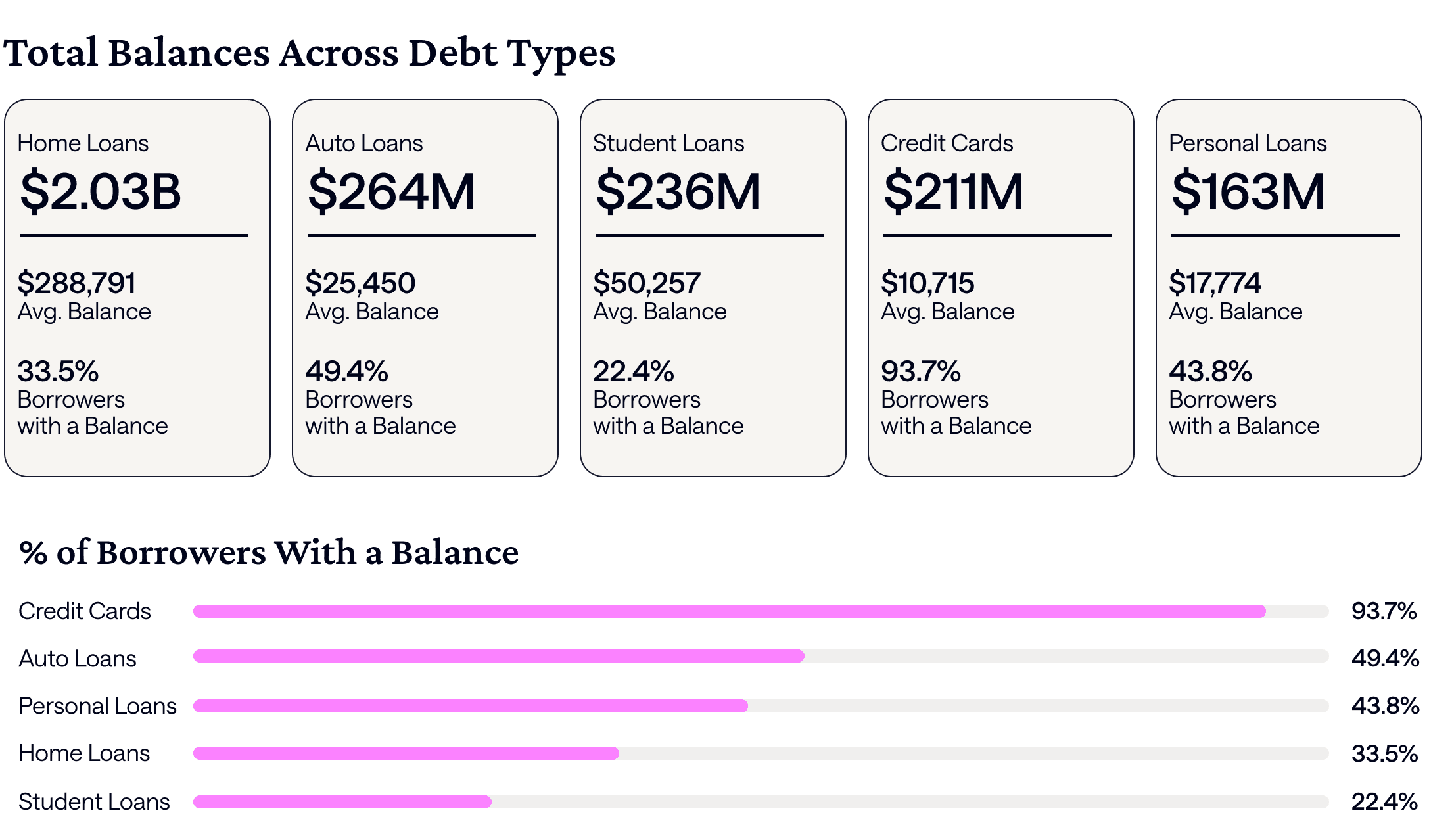
Perhaps unsurprisingly, mortgages account for the lion’s share of dollars owed by consumers. In fact, roughly 70 cents of every dollar goes towards a home loan. But, it’s also the debt type with the fewest number of borrowers.
By comparison, the most common type of debt is credit cards. Nine out of 10 consumers had a credit card balance at the time of this analysis. However, credit cards account for only 7.2% of total dollars owed.
More Credit Cards Equals Lower Utilization Rates
For most consumers, credit cards are simply a way of life. Most consumers carry one or more credit cards in a state of revolving-debt maintenance. But, Spinwheel’s data shows credit utilization rates change as consumers acquire more credit cards.
Conventional wisdom assumes more credit cards means more financial irresponsibility. But, the data says the opposite.
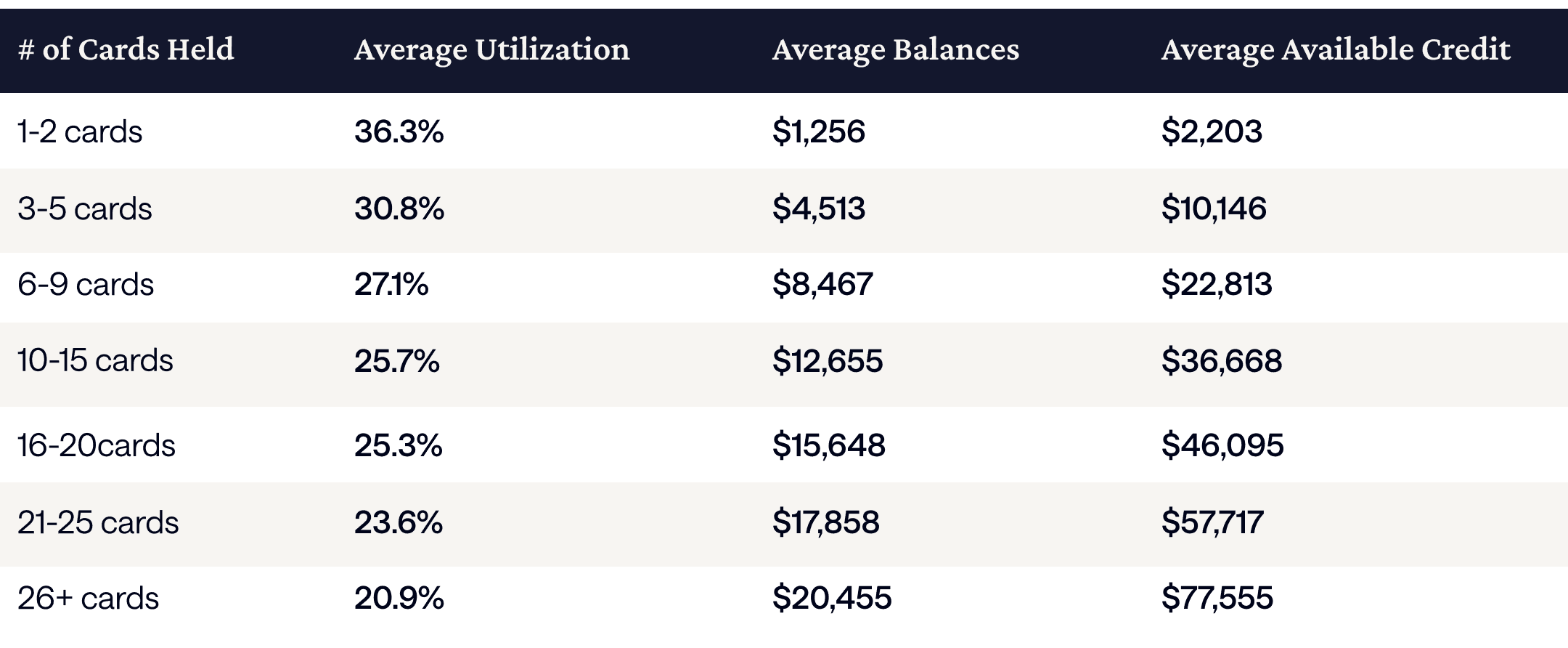
Consumers that hold more than 25 credit cards only utilize 20.9% of their available credit limits, compared to those with just 1 to 2 credit cards. Among this group (1 to 2 cards), consumers use an average 36.3% of their available credit.
This likely reflects a financially sophisticated subpopulation of consumers who are optimizing for rewards, taking advantage of low interest rates by opening new cards, and building credit by holding cards they don’t actively use.
Of course, high card counts alone do not guarantee financial stability. But within this dataset, larger card portfolios correlate with lower utilization rates rather than elevated borrowing pressure.
(Fun fact: Spinwheel’s data set shows one borrower with 170 different credit cards! For this outlier, the average utilization rate was 57.9% — showing there is indeed such a thing as too many cards.)
Intentional or not, having more cards is likely a credit-building strategy, not a symptom of distress. The U.S. credit system rewards this behavior unconditionally.
The Potential Debt Crisis Nobody Talks About
While most headlines focus on student and personal loans as a big driver of debt, they make up the smallest shares of debt in the United States. Aside from mortgages, our data shows a different debt type leading the way — both in share of all debt and total balances.
Auto loans are the top non-mortgage debt category by total dollars ($264M vs. $236M for student loans) and the second most common debt type at 49.4% of borrowers. And, unlike mortgages, auto loans are tied to a depreciating asset. The car, not the diploma, anchors American consumer debt.
Nearly half of consumers have auto loans with balances, surpassing student loan debt by more than double. The median auto payment is $582 per month — consuming 9.5% of the U.S. median household income with a single monthly car payment. This means the far larger and less visible crisis may be that Americans are systematically over-leveraged on depreciating assets.
Debt Composition by Credit Score
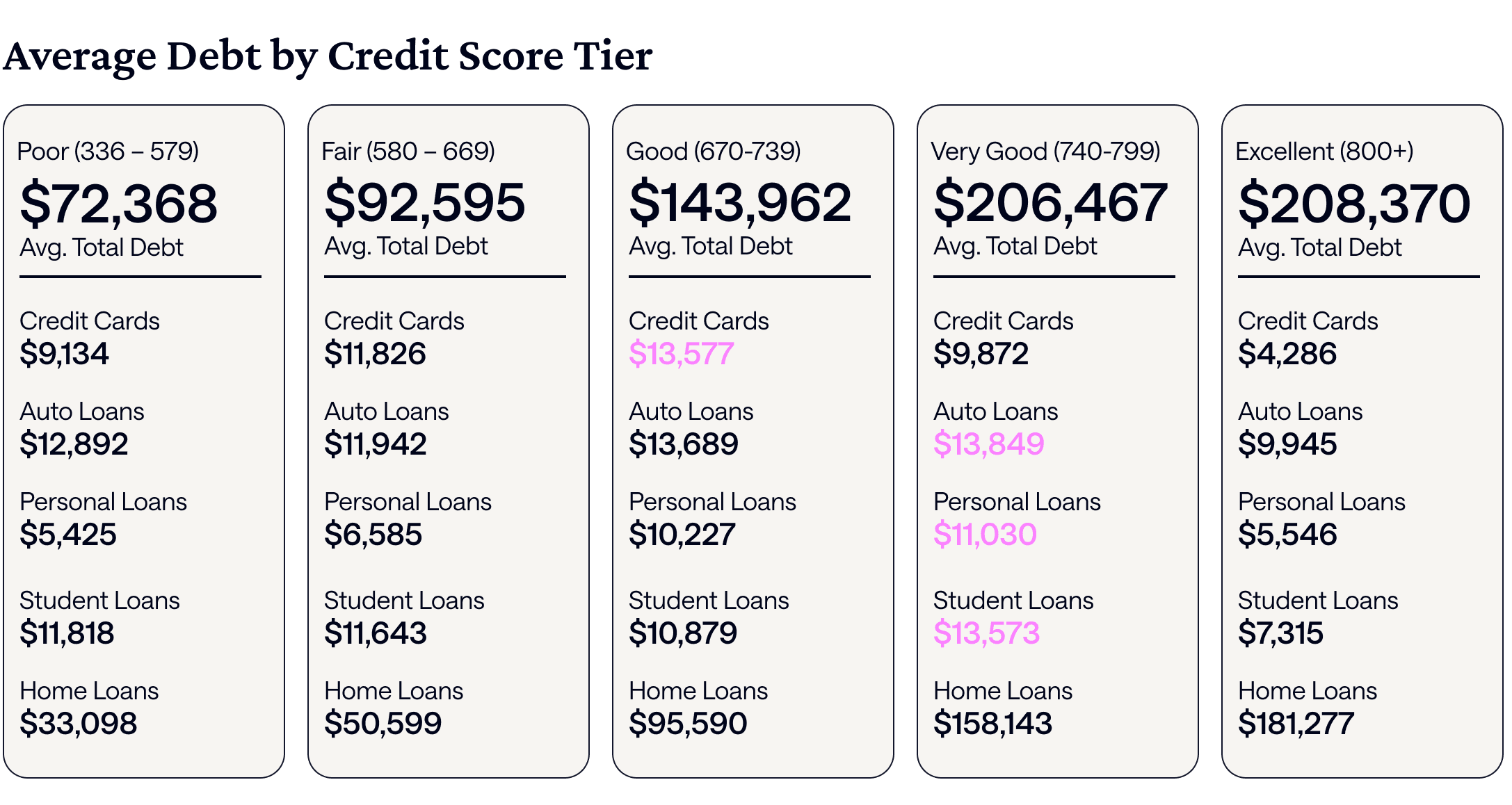
Looking at the average total debt across consumers, the average total debt grows steadily as credit scores improve — better access to credit means higher overall average debt balances. But, looking into the types of debt by credit score paints an interesting picture.
The Creditworthy Middle
Those with a “good” credit score (between 670 to 739) carry more credit card debt than any other group while those with “very good” credit scores (between 740 to 799) carry the most average debt across personal loans and student loans.
Why? These borrowers likely occupy a financially precarious middle ground: creditworthy enough to access large amounts of debt, but leveraged enough to prevent their scores from moving into the highest tier.
Excellent Scores Drive Less Unsecured Debt
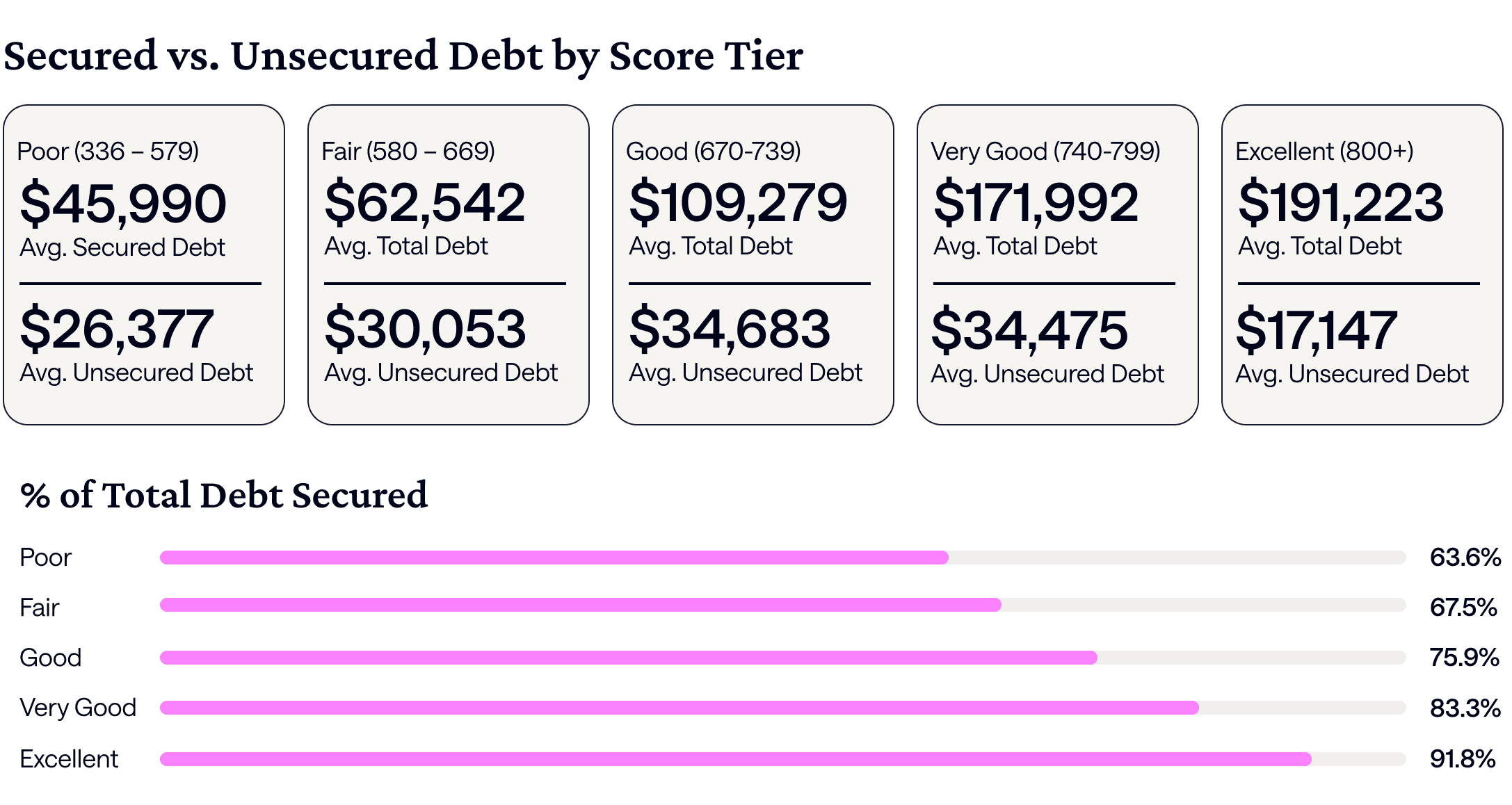
Among those with the highest credit scores, the data shows borrowers with the best credit scores carry less unsecured debt — those with “excellent” scores have the lowest average credit card and student loan balances of any tier.
The single biggest blind spot in an averages-only analysis of total debt is mixing different types of balance sheets. For instance, a $200K mortgage is completely different from $200K in credit card debt.
Bottom line: high-score borrowers carry more dollars but a much healthier mix. Secured balances grow by more than 4 times from borrowers with “poor” credit scores to “excellent” scores.
The Good and Bad of Credit
Debt itself is not inherently unhealthy. Modern financial life depends on it. The issue is that consumers are increasingly layering multiple forms of debt simultaneously — often within a credit system designed to evaluate accounts individually rather than holistically.
What once looked like a single monthly obligation has become a layered financial ecosystem of credit cards, auto loans, personal loans, installment plans, and revolving balances interacting simultaneously. As borrowers accumulate more debt types, financial pressure compounds faster than traditional metrics can capture.
That has major implications for how financial health is measured.
A credit score can indicate repayment consistency while masking rising obligations elsewhere. A borrower with 10 credit cards may actually be financially stable, while a borrower with only 1 credit card may already be approaching financial distress. Even the largest debt burdens are no longer concentrated where many institutions assume they are.
The result is a consumer credit system that often measures payment behavior more effectively than financial resilience. For lenders and fintechs, that means the next generation of underwriting and financial wellness tools cannot rely solely on isolated balances, utilization ratios, or credit scores.
As debt spreads across more products, providers, and repayment systems, financial visibility becomes increasingly fragmented for both consumers and institutions.
Understanding a consumer’s full debt profile — including how debt overlaps and how obligations compound once consumers move beyond a single debt type — may become one of the most important indicators of long-term financial risk.
This is because the clearest signal of financial strain is no longer how much debt consumers carry. It’s how many financial systems they’re trying to manage at once.

Jessica Kendall
Head of Content and Comms